The evolution of workflow orchestration has led organizations to migrate from traditional BPMN-based solutions like Camunda to modern, scalable, and highly reliable orchestration engines such as Orkes Conductor. Camunda, built on legacy BPMN standards, presents limitations in flexibility, scalability, and integration with modern microservices and event-driven architectures. Orkes Conductor, derived from Netflix Conductor, offers a cloud-native, microservices-driven, and highly scalable orchestration engine. This document provides a detailed comparison of the two platforms.
Orkes Conductor

Camunda (BPMN)
Deployment Models
Fully managed cloud (AWS, GCP, Azure), self-hosted, on-premise options
Primarily on-premise or cloud-hosted, but not as scalable
User Access Control
Granular RBAC with user groups, roles, secrets management
Basic role-based access
Cloud Support
Works seamlessly across multiple cloud providers and on-prem
Requires dedicated infrastructure setup
Security & SSO
Supports Okta, Azure AD, OAuth 2.0, and granular access controls
Basic security with limited SSO integrations
High Availability
Multi-region, multi-AZ support with up to 99.99% availability
Requires additional setup for high availability
Orkes Conductor
Camunda (BPMN)
Workflow Definitions
JSON-based DSL, decoupled from business logic
BPMN graphical notation, tightly coupled
Visual Workflow Builder
Fully visual, UI-driven workflow designer
Requires BPMN modeling tools
Versioning
Fully supported, easy rollback and migration
Limited, requires manual handling
Workflow Definition Decoupling
Completely decoupled from task execution
Tightly coupled with execution logic
Built-in System Tasks
Provides native support for HTTP calls, Kafka, AWS Lambda, and more
Requires manual scripting for external integrations
Integrations
Prebuilt integrations with Kafka, SQS, AI/LLMs, and vector databases
Requires custom adapters for integrations
Human Tasks
Supports human-in-the-loop workflows with task approvals
Manual handling via BPMN forms
Orkes Conductor
Camunda (BPMN)
Massive Parallelism
Run tens of thousands of parallel tasks per workflow and millions of workflows daily—engineered to scale to billions
Limited parallel execution, can cause bottlenecks
Error Handling & Compensation
Automated retry mechanisms, error handling, and compensating workflows
Basic error handling via BPMN flows
Scalability
High-scale support with multi-region deployments
Limited by single-node constraints
AI Orchestration
Integrates with LLMs, AI APIs, and vector DBs for advanced automation
No native AI support
Long-Running Workflows
Supports workflows of unlimited duration with dynamic event handling
Requires BPMN timers and event triggers
Orkes Conductor
Camunda (BPMN)
Workflow Monitoring
Real-time workflow monitoring with visual insights
Limited workflow monitoring capabilities
Execution Visualization
Full execution history with timeline-based debugging
Requires external logging and analysis
Task-Level Debugging
Granular debugging with real-time task execution logs
Requires manual log analysis
Error Identification
Built-in error tracing with automated resolution suggestions
Manual error tracking through BPMN logs
Audit Trails
Comprehensive audit logs with event-driven insights
Limited audit and traceability
Orkes Conductor
Camunda (BPMN)
AI Agents
Supports AI-powered agents that autonomously trigger workflows and make decisions based on real-time data
No AI agent support
LLM Integration
Seamless integration with Large Language Models (LLMs) for intelligent automation and NLP-driven workflows
No native LLM support
Predictive Orchestration
AI-driven insights to optimize workflow execution paths and task allocation
No predictive intelligence features
Automated Decision Making
AI-based rules engine to dynamically adjust workflows based on contextual data
Relies on predefined BPMN decision tables
Conversational AI Workflows
Ability to integrate with chatbot and voice interfaces for automated interactions
Requires external tools for conversational AI
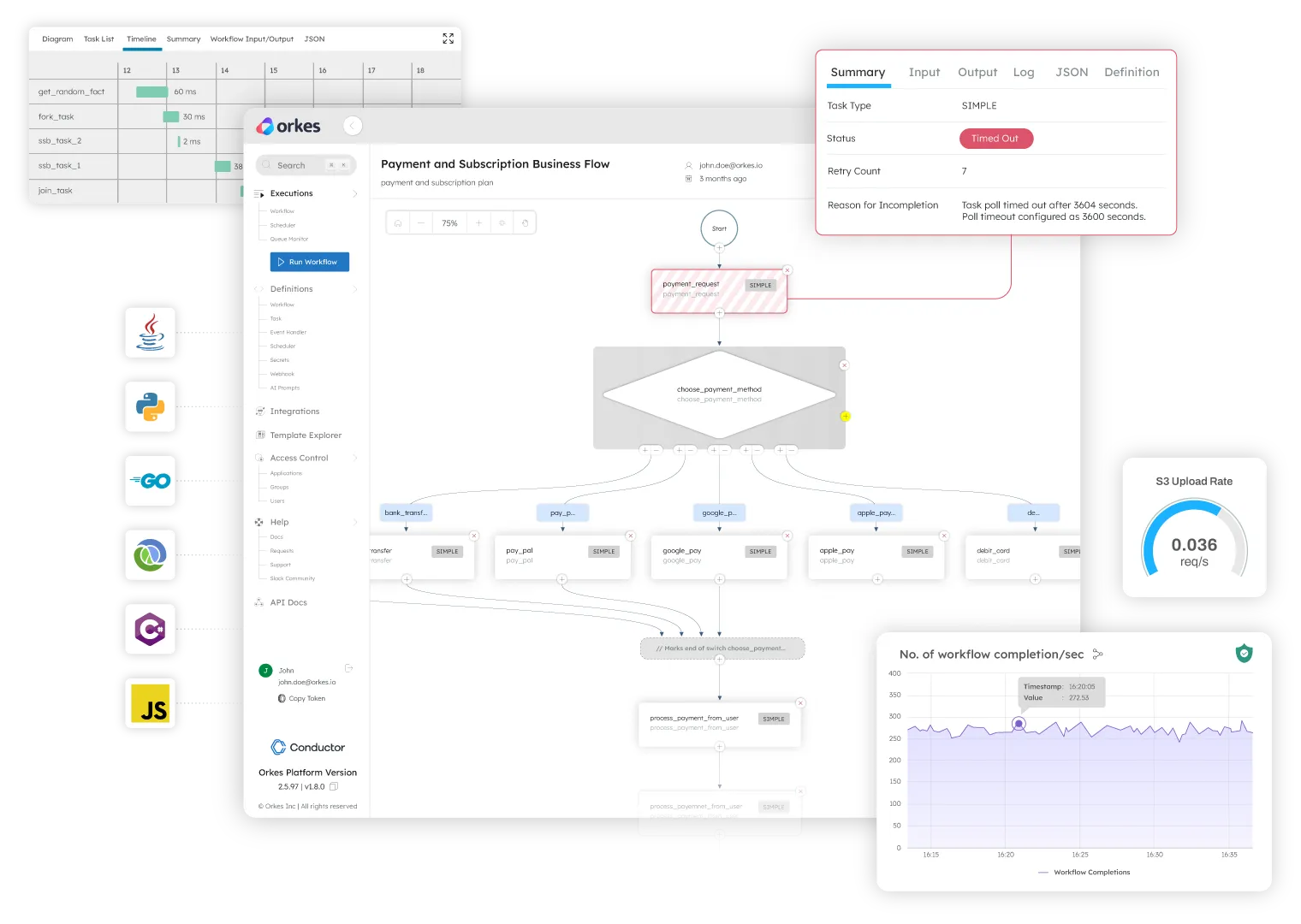
Not primarily. Camunda comes from the BPMN and traditional business process automation world, built around visual process modeling for business analysts. Orkes is built for developers and engineering teams, orchestrating code, services, and now AI agents, with Conductor's JSON-based workflow definitions rather than BPMN diagrams.
Camunda has added AI-related capabilities to its platform, but its architecture and tooling are still rooted in classical BPM process automation. Orkes was purpose-extended for agentic use cases through Agentspan, giving agents a durable runtime with retries, checkpoints, and audit trails natively rather than as an add-on to a BPM engine.
Orkes is code-first and API-first: developers define and version workflows the same way they manage other infrastructure, and can iterate quickly without going through a separate business-process modeling layer. Camunda's BPMN modeler is powerful for business-analyst-driven processes but tends to add ceremony for engineering teams that just want to orchestrate services and agents.
Yes. Orkes provides full execution history, versioning, and audit trails for every workflow run, which matters for regulated industries like financial services. This is delivered through Conductor's execution model rather than BPMN process governance, so the audit trail is centered on system and agent behavior rather than business-process compliance artifacts.
If the primary need is business analysts modeling and owning process flows in BPMN notation, Camunda's tooling is purpose-built for that. If the primary need is engineering teams orchestrating services, APIs, and AI agents with production-grade durability, Orkes is built for that use case first.
Camunda is often used to modernize legacy BPM systems within the same BPMN paradigm. Orkes is frequently chosen when teams want to move off legacy orchestration or BPM tooling entirely and rebuild on a developer-native, code-first foundation, including cases where AI agents are being introduced into previously manual or rules-based processes.
Yes, this is common in phased modernization efforts. Teams often keep Camunda running existing BPMN processes while standing up Orkes for new services, agent-driven workflows, or specific high-throughput use cases, then migrate incrementally as confidence builds.
Yes. Orkes includes a BPMN importer that converts supported .bpmn or XML process definitions into Conductor workflows. This gives teams a practical starting point for moving existing Camunda processes to Orkes without manually rebuilding every workflow.
Teams upload an existing BPMN or XML file, and Orkes converts the process definition into a Conductor workflow. The imported workflow can then be reviewed, tested, versioned, and extended using the Orkes visual workflow editor, APIs, or SDKs.